
Mount Hudson
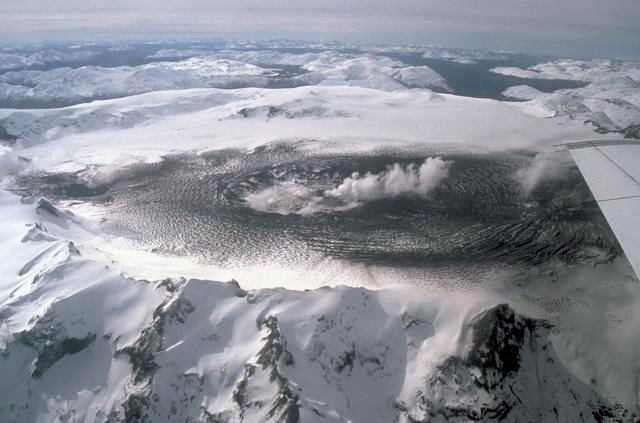
Hudson Volcano (Spanish: Volcán Hudson, Cerro Hudson, or Monte Hudson) is the most active volcano in the southern part of the Southern Volcanic Zone of the Andes Mountains in Chile, having erupted most recently in 2011. It was formed by the subduction of the oceanic Nazca Plate under the continental South American Plate. South of Hudson is a smaller volcano, followed by a long gap without active volcanoes, then the Austral Volcanic Zone. Hudson has the form of a 10-kilometre-wide (6-mile) caldera filled with ice; the Huemules Glacier emerges from the northwestern side of the caldera. The volcano has erupted rocks ranging from basalt to rhyolite, but large parts of the caldera are formed by non-volcanic rocks. The volcano erupted numerous times in the late Pleistocene and Holocene, forming widespread tephra deposits both in the proximity of Hudson and in the wider region. Four large eruptions took place in 17,300–17,440 BP ("H0 eruption"), 7,750 BP ("H1 eruption"), 4,200 BP ("H2 erupti
Elevation: 1763 m
Country: Australia
Explore topics:
- Mount Hudson hiking routes
- Mount Hudson best routes
- Mount Hudson camping
- Mount Hudson parking
- Mount Hudson car park
- Mount Hudson difficulty
- Mount Hudson family friendly
- Mount Hudson dog friendly
- Mount Hudson sunrise hike
- Mount Hudson sunset hike
Related mountains in Australia
- Abbott Peak
- Abbotts Lookout
- Abel Peak
- Aberfoyle Sugarloaf
- Abrotanella Rise
- Adams Peak
- Adamsons Peak
- Addicumbene
- Adla Hill
- Airmid Dome